A few years ago, we had a fantastic Grand Canyon backpacking trip. We spent seven days exploring the Clear Creek area. The group was strong and experienced. We had hiked with them many times before.
Ed and I take a moment to view Zoroaster Temple. The Brittlebush blooms were amazing. Our most experience team member, Ginger (who helped build the Deer Creek Trail), called the Brittlebush an exotic native, and that was edging it's way into the Grand Canyon from the Mohave side.
Almost to Sumner Wash. Here are the troops: Mike, Jim, Gary, and Ginger.
After nine long, Grand Canyon miles, we are finally looking down into the Clear Creek Canyon.
You can see the deep green of the Fremont Cottonwood Trees, waaayy down in the canyon bottom. When you see Cottonwoods in the desert, you know there is water there.
The hillsides are painted yellow with the best Brittle Bush bloom that I have ever seen.
This is a text-book example of fossilized mud-cracks. Thanks for being our 'hand model', Ed.
On our layover day, we bushwhacked up to Cheyava Falls.
Cheyava is a Hopi word for 'on again-off again', describing the intermittent nature of this waterfall.
Pouring out of a vast cavern system, deep within the Redwall Limestone, Cheyava's 800' drop makes it the Grand Canyon's tallest waterfall.
Signs of ancient life. These Ancestral Puebloan granaries are a highlight of the hike to Cheyava.
Nestled high up on the cliff side, granaries were a way the ancient ones ensured themselves seeds for the next years crop.
WHOA,,,, who is this Canyon Beauty.... oh, it's my lovely wife, Ryanne Sebern.
This place was so great that my wife, Ryanne Sebern, made me promise not to disclose the exact location. Our hidden paradise was just north of Laughlin, on the way to Las Vegas. It was Mohave camping at is best.
Here is Ryanne hauling our gear into the desert wilderness.
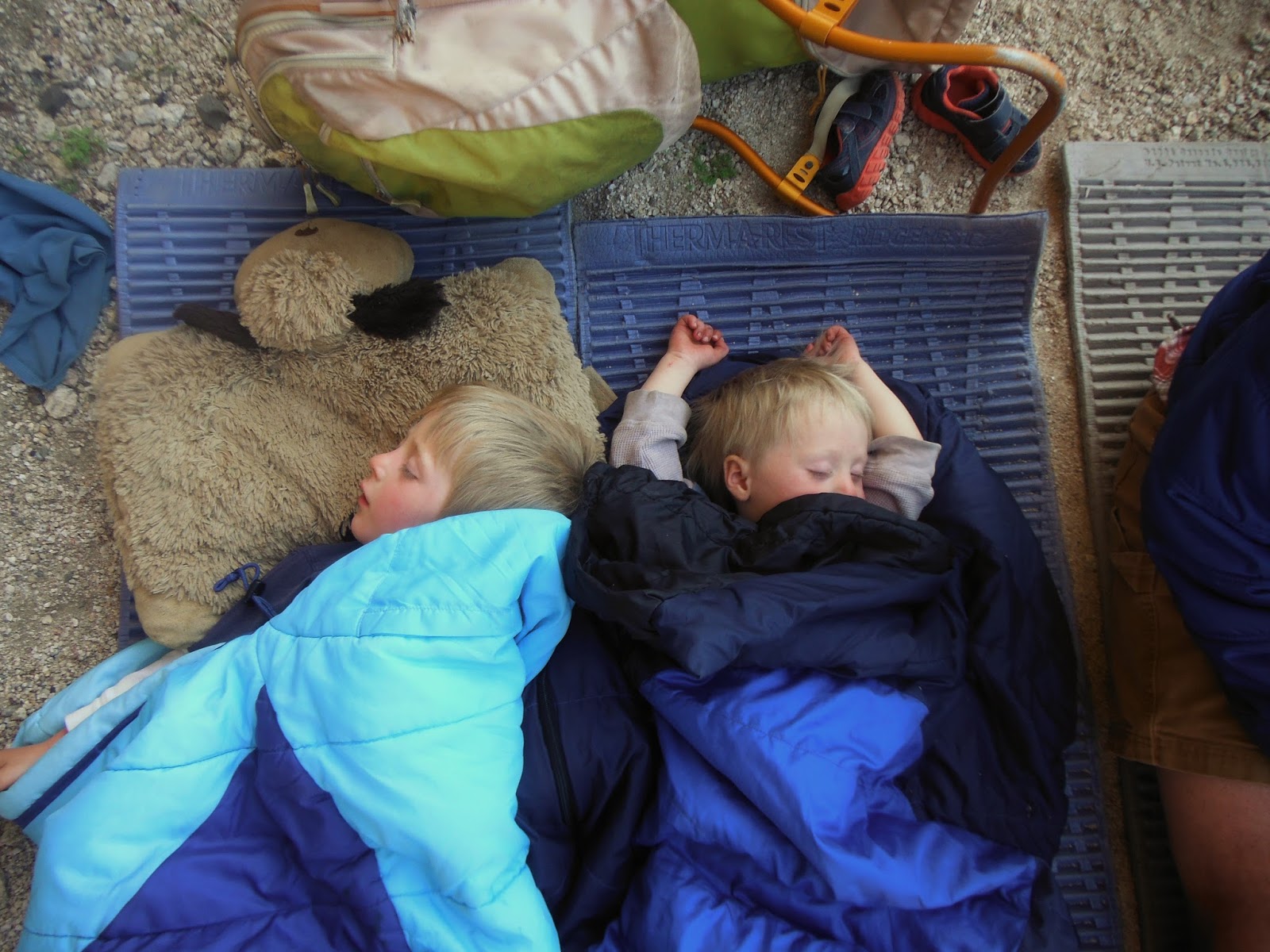
We wanted to give the boys a "back packing" experience, so we hiked about a quarter mile in from the road. Our secluded camp was tucked in among some granite domes.
Orin and I are heading back to camp, after a bit of exploring.
Orin peaking out of a hueco cave.
The granite domes had weathered, hueco caves that were fun to explore.
While on a family trip to Oregon, we took a trip to the Coast to see the famous Peter Iredale shipwreck. I remember seeing it, as a kid. So, I was really interested to find out what it looks like after forty years.
On our way to the coast, we stopped off at the Jewell Meadows Elk Sanctuary. The boys had a blast seeing all the big, antlered bull elk.
Eagan Ford spends some time sitting on a fence rail watching the elk go by.
While at the elk sanctuary I noticed this super tiny mushroom, growing on a mossy tree. The mushroom cap was approximately 2 mm wide.
Micro Mushroom
What a rarity to have a sunny day on the Oregon Coast. Here is a view to the south.
Looking down the beach. Sunny days, Hurray!!!
Queen of the Mountain
My beautiful wife, Ryanne Sebern, climbs to the top of a nearby sand dune.
Here is our first view of the Peter Iredale shipwreck.
Remnants of a once mighty ship, the Peter Iredale. Foundered off the Oregon Coast.
Here is a perspective picture to show just how big this ship was.
The Peter Iredale, bow to stern
Vintage picture of the Peter Iredale, shortly after the wreck.
The Space Saver Mug lovingly nests around your Nalgene Bottle. This mug is lightweight and durable. You can cook with it, too! For the Minimalist Backpacker, the Space Saver Mug is all you need for your backcountry adventures.
I found this first bloom of the Beavertail Prickly Pear hidden by the Mormon Tea. We were climbing up the Bonsai Route, out of the Bright Angel Campground.
Opuntia basilaris, the beavertail cactus or beavertail pricklypear, is a cactus species found in southwestUnited States. It occurs mostly in the Mojave Desert, Anza-Borrego Desert State Park, and Colorado Deserts, and also in the Colorado Plateau and northwest Mexico; it ranges through the Grand Canyon and Colorado River region to southern Utah, and in western Arizona, regions along the Lower Colorado River Valley. The Beavertail Cactus is a medium-sized to small prickly pearcactus, depending on variety, growing to about 60 cm tall. A single plant may consist of hundreds of fleshy, flattened pads. These are more or less blue-gray, depending on variety, growing to a length of 14 cm and are maximum 10 cm wide and 1 to 1.5 cm thick. They are typically spineless, but have instead many small barbed bristles, called glochids, that easily penetrate the skin. The pink to rose colored flowers are most common; however, a rare variety of white and even yellow flowers also exist. Opuntia basilaris bloom from spring to early summer. Here is a new flower, to me. It is the Desert Anemone, or Windflower. We saw these beauties while hiking the red, slickrock sandstone of Utah Flats.
Anemone tuberosa (desert anemone or tuber anemone) is a herbaceous plant species in the genus Anemone and family Ranunculaceae. Plants grow 10 to 30, sometimes 40 cm tall, from a woody-like tuber shaped like a caudex. Plants with 1 to 3 basal leaves that are 1 or 2 times ternate. The basal leaves few with long petioles and deeply 3-parted with leaflets lacking stems or rarely with a stalk. Plants flowering early to late spring with the flowers composed of 8 to 10 sepals normally white or pink colored, 10 to 14 mm long. The plants produce one peduncle with one solitary flower or 2-5 flowered cymes. Fruits in heads fusiform in shape, with 7-20 cm long pedicels. Fruits called achenes measure 2.5-3.5 mm long and 2-2.5 mm wide with a rounded outline and flat in shape, densely woolly, not winged also with straight 1.5 mm long breaks.
Anemone tuberosa is native to south central western North America mostly in Nevada and New Mexico and Northern Mexico but also west to California and East to Texas. This spring flowering plant is found on rocky slopes and along stream banks. Anemone tuberosa is part of a species complex that includes 6 to 9 species native from south western and central USA to South America For the most part all produce tubers or caudex-like tubers.
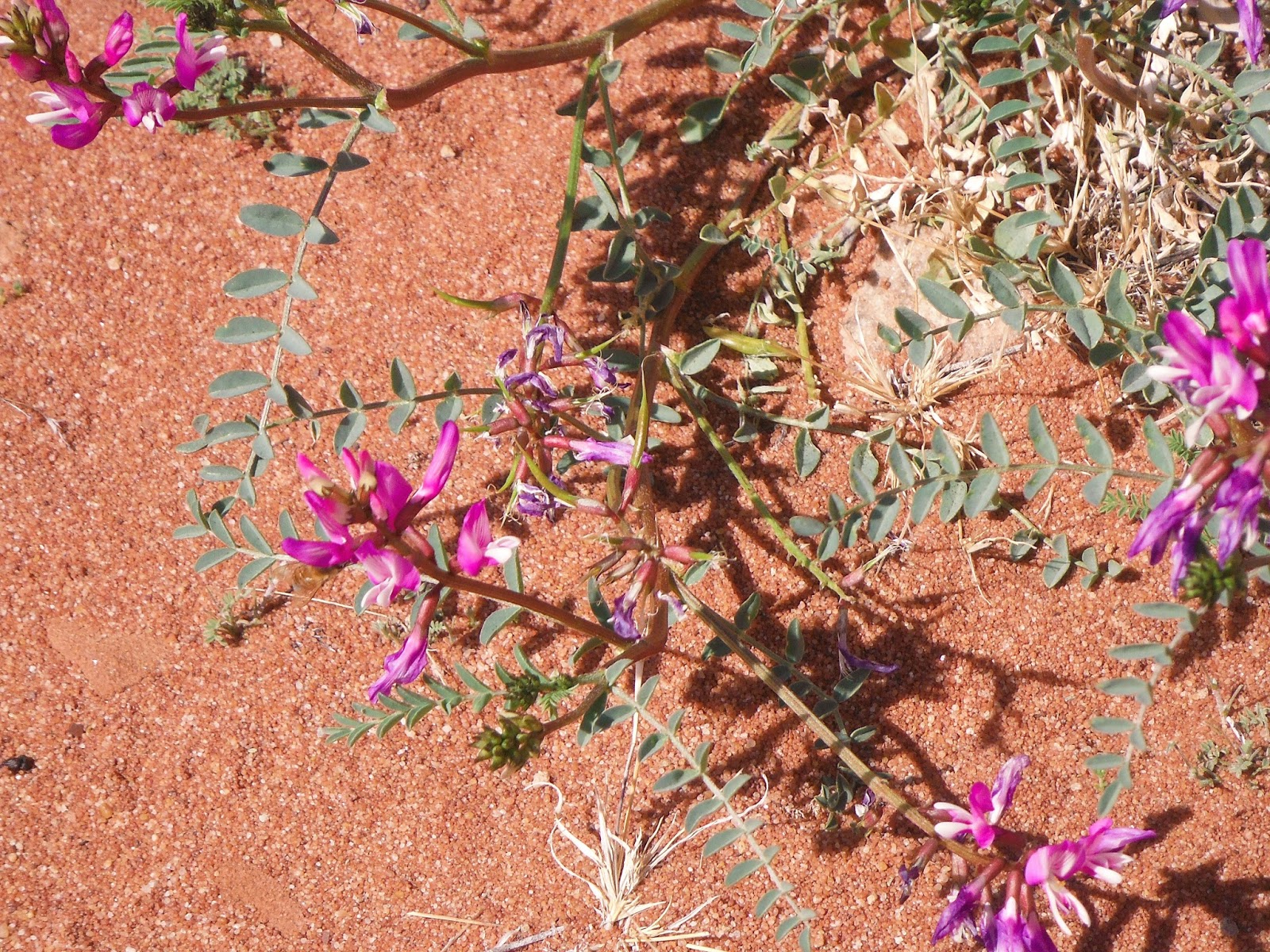
The always lovely Milk Vetch. I really liked the course pink sand as the backdrop for this picture. It shone like little desert jewels, a nice contrast to the purple flower.
Astragalus is a large genus of about 3,000 species of herbs and small shrubs, belonging to the legume family Fabaceae and the subfamilyFaboideae. It is the largest genus of plants in terms of described species.[1] The genus is native to temperate regions of the Northern Hemisphere. Common names include milkvetch (most species), locoweed(in North America, some species)[2] and goat's-thorn (A. gummifer, A. tragacanthus). Some pale-flowered vetches are similar in appearance, but vetches are more vine-like